
Practical Guide
Sardinia for U.S. Travelers
Entry rules, money, phones, plugs, driving — the small stuff no one explains until you're already there.
Before you fly
- Passport: valid at least 3 months past your return date.
- ETIAS: required in 2026 for U.S. citizens. €7, valid 3 years, apply online at least 96 hours before departure.
- International Driving Permit: $20 at AAA if you're renting a car. Technically required to drive in Italy — most rental agencies won't ask, but the police can.
- Travel insurance: recommended. U.S. health insurance doesn't work in Italy.
- Notify your bank: quick travel note on your credit/debit cards to avoid fraud freezes.
Money & payments
The Euro is the only accepted currency. Skip currency exchanges — pull cash from an ATM (called Bancomat) when you arrive. Bring a credit card with no foreign transaction fee — Chase Sapphire, Capital One Venture, and most travel cards qualify. Contactless payments (Apple Pay, Google Pay) work at almost every register.
Prices in Sardinia are generally cheaper than New York for food and drink — a good pizza is €10–14, a bottle of local Vermentino €18–25. Beach umbrellas at private beach clubs are the exception (€30–80/day for two loungers in high season).
Driving in Sardinia
Same side as the U.S. (right). Automatic-transmission rentals are limited and pricier — book early. Speed limits: 50 km/h in town, 90 on secondary roads, 110–130 on the highway (mostly on the mainland). ZTL zones (limited-traffic zones in historic centers) don't really apply in Palau but exist in Cagliari and Alghero — respect the signs or expect a fine in the mail 6 months later.
Gas stations are self-service (\"fai da te\") at the pump, or attended (\"servito\") for ~€0.15/L more. Diesel is called gasolio. Parking meters accept coins and cards; blue lines = paid, white lines = free, yellow lines = residents only.
Eating & tipping like a local
- Dinner starts at 8 PM, not 6. Restaurants that open earlier are tourist traps.
- Water is ordered (\"naturale\" or \"frizzante\") — you won't get free tap water automatically.
- Cappuccino is a breakfast drink. Order it after noon and expect a raised eyebrow.
- Tipping is optional. Round up or leave €1–2 for good service. No 20%.
- Ask for local specialties: fregola con arselle, culurgiones, porceddu (roast suckling pig), Vermentino di Gallura wine.
Base yourself in Palau
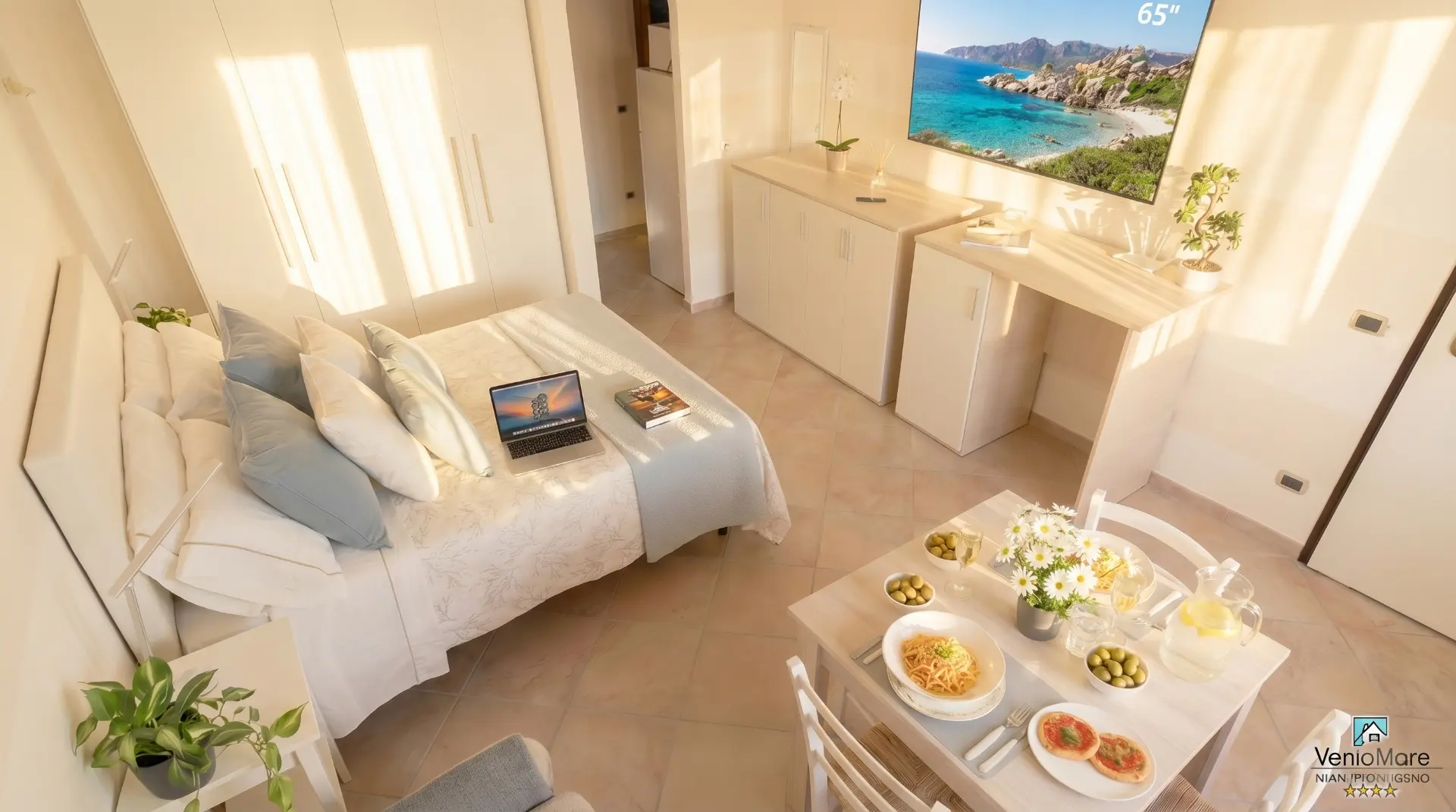
After a transatlantic flight and airport pickup, you want somewhere easy. Vento e Mare offers five self-catering apartments in Palau's old town — 10 minutes on foot from the ferry port for the Maddalena archipelago. A/C, Wi-Fi, private parking, and 24/7 keybox self check-in: land whenever, walk in whenever, no jet-lagged front-desk wait.
Frequently asked questions
Do Americans need a visa to visit Sardinia?
No visa for stays under 90 days. Starting in 2026 you'll need ETIAS ($7 / €7, valid 3 years) — apply online a few days before travel. Passport valid at least 3 months beyond your return date.
What currency is used in Sardinia?
The Euro (€). ATMs are widely available in Palau, La Maddalena and around the Costa Smeralda. Skip the airport exchange booths — rates are bad. Use a debit card with no foreign ATM fees (Charles Schwab, Fidelity, Capital One 360).
Can I use my U.S. credit card in Sardinia?
Yes — Visa and Mastercard are accepted almost everywhere, including small trattorias. American Express less so (rural spots may decline it). Use a card with no foreign transaction fee. Contactless (Apple Pay, Google Pay) works widely.
Do I need to tip in Italian restaurants?
No — tipping isn't expected. Many bills already include a small "coperto" (cover charge, €1–3 per person). Round up or leave €1–2 for great service. Don't tip 15–20% like in the U.S. — servers earn a real wage.
Will my U.S. phone work in Sardinia?
Yes if it's unlocked and supports 4G/5G LTE bands used in Europe. Options: (1) international roaming from your carrier (Verizon/AT&T ~$10/day, T-Mobile Magenta plans include Europe free), (2) an eSIM (Airalo, Holafly — $10–30 for the week), (3) a local Italian SIM (TIM, Vodafone) at Olbia airport.
What side of the road do they drive on?
Right side, like the U.S. Most rentals are manual transmission — request automatic explicitly and expect to pay 30–50% more. Coastal roads are narrow and curvy but scenic; there are tolls on the mainland but almost none on Sardinia. International Driving Permit (IDP) is technically required — get one at any AAA office for $20 before you leave.
What are the electrical outlets like?
Italy uses Type C and Type F plugs at 230V, 50Hz. You need a physical plug adapter (not a converter) — most phones, laptops, cameras, e-readers handle 100–240V automatically. Hair dryers and curling irons bought in the U.S. often burn out; buy or borrow local.
Is the tap water drinkable?
Yes, tap water in Sardinia is safe. Locals often prefer bottled sparkling water at meals ("frizzante" or "gassata") — restaurants will ask.